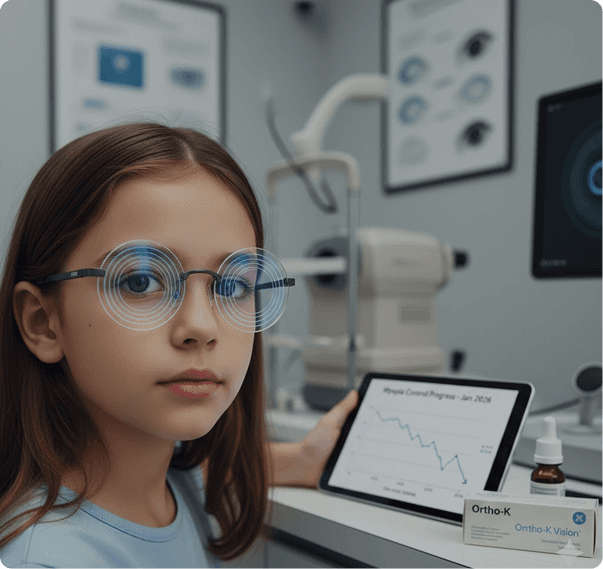
Myopia control is a proactive approach to slowing the progression of nearsightedness in children. While glasses can correct blurry distance vision, they don’t stop the eye from continuing to grow longer over time. Myopia control treatments are designed to help manage that growth, reducing the risk of stronger prescriptions and protecting long-term eye health.
Myopia Control: What Parents Need to Know
Myopia—also known as nearsightedness—is very common. In fact, nearly 1 in 2 people have it. When a child has myopia, the eye grows longer than normal from front to back, or the cornea (the clear front surface of the eye) is too curved. This causes distant objects to look blurry.
Glasses and contact lenses can correct blurry vision. Surgery can reduce dependence on glasses later in life. But here’s what many parents don’t realize:
Myopia is not just about needing stronger glasses.
As myopia increases, so does the lifetime risk of eye conditions such as cataracts, glaucoma, retinal detachment, and myopic macular degeneration.
That’s why myopia control is so important.
What Is Myopia Control?
Myopia control focuses on slowing down the progression of nearsightedness in children.
Myopia cannot be reversed. But it can often be slowed.
When myopia progresses, the eye continues to grow longer than it should. This extra growth stretches the delicate tissues inside the eye and increases the risk of eye disease later in life.
The goal of myopia control is to:
Slow eye growth
Reduce how quickly prescriptions increase
Lower long-term eye health risks
Protect your child’s vision for the future
Why Is Myopia Becoming More Common?
Studies show myopia is increasing worldwide, especially in children.
Research suggests children who spend more time indoors doing near-focused activities—like reading, tablet use, computer work, and video games—have higher rates of myopia than children who spend more time outdoors.
While screen time alone doesn’t “cause” myopia, prolonged near work and limited outdoor exposure are associated with faster progression.
Encouraging outdoor time (around 2 hours daily when possible) may help delay onset and support treatment.
Why Slowing Myopia Matters
Even low levels of myopia increase risk of eye disease compared to someone who is not nearsighted.
As prescriptions increase, so do the risks.
Higher myopia is associated with:
Retinal detachment
Glaucoma
Cataracts
Myopic macular degeneration
Each additional diopter (–1.00D) increases long-term risk.
Myopia control is about reducing the final prescription your child ends up with — and protecting their lifelong eye health.
Myopia Control Treatment Options
There are several evidence-based options available. Treatment is personalized based on age, prescription, lifestyle, and rate of progression.
Low-Dose Atropine Eye Drops
Low-dose atropine drops are placed in the eyes nightly before bedtime. When used for 2–3 years, they have been shown to slow myopia progression.
Doctors believe atropine helps slow excessive eye growth, although the exact mechanism is still being studied.
At low doses, side effects are minimal and may include mild redness or irritation.
Atropine is commonly used in children between ages 5 and 18.
Peripheral Defocus (Multifocal) Contact Lenses
These specially designed soft contact lenses look similar to regular contacts but work differently.
The center of the lens corrects distance vision. The outer portions gently blur peripheral vision. This peripheral defocus is thought to reduce the signal that drives the eye to grow longer.
These lenses are often used in children ages 6 to 12 and may be especially helpful for children whose prescriptions are steadily increasing.
As with all contact lenses, proper hygiene and follow-up care are essential to reduce infection risk.
Orthokeratology (Ortho-K)
Orthokeratology involves custom-designed lenses worn overnight. While your child sleeps, the lenses gently reshape the cornea.
In the morning, the lenses are removed, and your child can see clearly throughout the day without glasses or contacts.
Ortho-K provides temporary vision correction but may also slow myopia progression over time.
Because these lenses are worn overnight, careful fitting and regular monitoring are important.
What About Regular Glasses?
Traditional single-vision glasses and standard contact lenses correct blurry vision while being worn. However, they do not slow myopia progression.
Specialty myopia control treatments are different — they aim to manage eye growth, not just clarity.
Does Laser Eye Surgery Fix Myopia?
Laser surgery (such as LASIK) can reduce dependence on glasses in adulthood, but it does not change the length of the eye.
If the eye grew longer during childhood, the increased lifetime risk of eye disease remains — even after surgery.
We do not perform LASIK in-office, but we work closely with trusted refractive surgeons. We provide comprehensive pre-operative evaluations to determine candidacy, educate patients about risks and expectations, refer directly to experienced surgeons, and continue post-operative follow-up care in our office. This ensures continuity of care with a doctor you already know and trust.
When Should Myopia Control Start?
Children ages 6–10 tend to experience the fastest progression.
Starting treatment early often leads to better long-term outcomes.
Myopia control is typically continued through the teenage years until eye growth stabilizes.
Some young adults may also continue to progress into their early 20s, so monitoring remains important.
What You Can Do at Home
Lifestyle plays an important role in myopia management.
Encourage:
More outdoor time
Regular breaks from screens (20-20-20 rule)
Holding books and devices at a proper distance
Limiting prolonged near work without breaks
These habits support healthy visual development.
The Big Picture: Myopia Is a Health Condition
Myopia is not just about glasses.
It is a structural change in the eye that can increase lifelong health risks. The World Health Organization recognizes myopia as a growing global health concern.
The good news?
We now have effective tools to slow progression.
Myopia control can mean:
Fewer prescription changes
Better visual stability for school and sports
Lower lifetime risk of serious eye disease
Improved quality of life
Schedule a Myopia Control Consultation
If your child’s prescription is increasing each year, don’t wait for it to “stabilize.”
Early action makes a difference.
We offer comprehensive myopia evaluations and personalized treatment plans designed to protect your child’s vision now — and for the future.
Contact our office to schedule a consultation and learn which myopia control option is right for your child.